A complete guide to the Election Commission of India (ECI): structure, powers, responsibilities, election process, voter services, and important functions. Updated information for 2025.
Election Commission of India: Full Guide (Structure, Powers & Role)
The Election Commission of India (ECI) is one of the most important constitutional bodies responsible for conducting free, fair, and transparent elections across the country. Established on 25 January 1950, the Commission ensures that every election—from Lok Sabha to Rajya Sabha, State Assemblies, and even the President and Vice-President—is carried out without bias or influence.
In this post, we cover everything about the Election Commission of India—its history, composition, powers, responsibilities, and voter-related services.
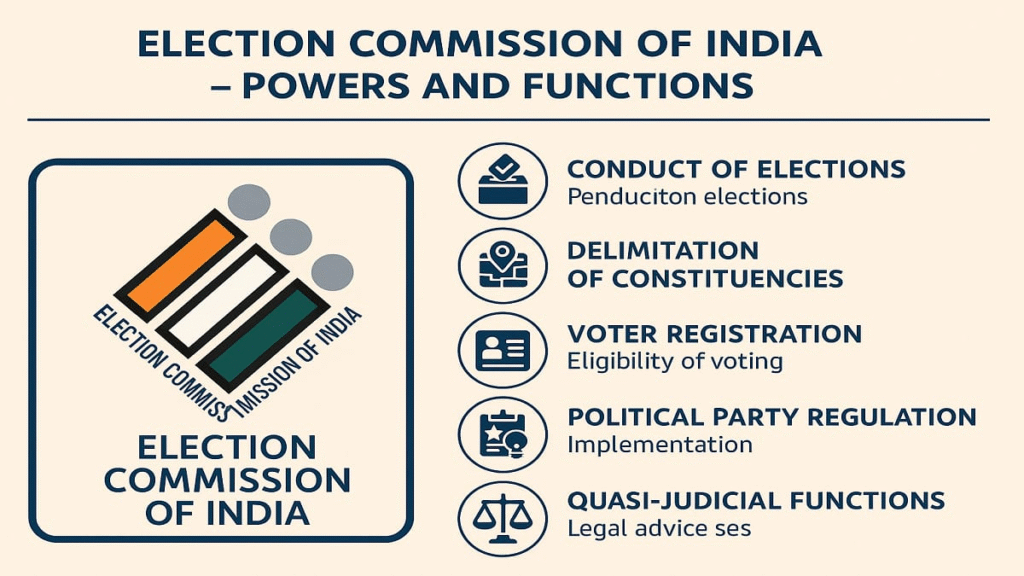
What is the Election Commission of India?
The Election Commission of India is an autonomous constitutional authority formed under Article 324 of the Indian Constitution. Its primary role is to organize and supervise all elections in India.
It ensures:
- Free and fair voting
- No political influence
- Proper voter registration
- Election rules and guidelines
- Prevention of malpractices
- Transparent counting and result declaration
Formation & Background
Formed on: 25 January 1950
Constitutional Article: 324
Headquarters: New Delhi
Motto: “Free, Fair & Inclusive Elections”
National Voters Day: 25 January
Composition of the Election Commission
The ECI consists of:
- Chief Election Commissioner (CEC)
- Election Commissioners (usually two)
Together, they form a three-member commission. All decisions are taken collectively.
Important Functions of the Election Commission of India
Here are the major responsibilities of the ECI:
1️⃣ Conducting Elections
ECI organizes elections for:
- Lok Sabha
- Rajya Sabha
- State Legislative Assemblies
- President & Vice-President
- Local body elections in some states
2️⃣ Voter Registration & Electoral Roll Preparation
ECI prepares, updates, and publishes the voter list (electoral roll) to ensure only eligible citizens vote.
3️⃣ Model Code of Conduct (MCC)
ECI enforces the MCC:
- Restricts political parties from unfair practices
- Maintains decorum during elections
4️⃣ Monitoring Election Expenditure
A strict limit is set on campaign funds.
ECI tracks and audits all candidate expenditures.
5️⃣ EVM & VVPAT Management
ECI oversees:
- Electronic Voting Machines
- Voter Verified Paper Audit Trail
This improves transparency and reduces fraud.
6️⃣ Election Disputes & Complaints
ECI has the authority to:
- Resolve complaints
- Take action on violations
- Suspend candidates or parties when needed
7️⃣ Political Party Registration
ECI registers political parties and categorizes them as:
- National Parties
- State Parties
- Registered Unrecognised Parties
Powers of the Election Commission
Under the Constitution, ECI has wide powers, including:
- Supervising all election processes
- Taking strict action against misconduct
- Postponing or cancelling elections if needed
- Deploying central forces for security
- Ordering repolls
- Enforcing election laws
ECI’s decisions are final and binding during elections.
Election Process Managed by ECI
ECI supervises the entire election cycle:
- Announcement of election dates
- Filing, scrutiny & withdrawal of nominations
- Campaign monitoring
- Polling arrangements
- Security deployment
- EVM/VVPAT setup
- Counting of votes
- Declaration of results
Online Services Provided by ECI
🔗 Important Links
- Official Website: https://eci.gov.in
- Voter Registration (NVSP): https://nvsp.in
- Voter Helpline App: Available on Play Store
- Search Name in Voter List: https://electoralsearch.eci.gov.in
- Download Voter ID (e-EPIC): https://voterportal.eci.gov.in
Voter Awareness Programs
ECI runs many campaigns like:
- SVEEP (Systematic Voters’ Education and Electoral Participation)
- Awareness rallies
- College voter drives
- Social media campaigns
These programs focus on improving voter turnout.
Why the ECI is Important?
The Election Commission ensures:
- Democracy stays strong
- Elections remain neutral
- Every citizen gets equal voting rights
- Political parties follow rules
- Corruption is minimized
Without ECI, India cannot hold free and fair elections.
The Election Commission of India (ECI) is the backbone of the world’s largest democracy. From conducting elections to ensuring voter transparency, the ECI plays a crucial role in maintaining the democratic framework of India.
Current Role of the ECI in the Bihar 2025 Vote Counting
In the ongoing counting for the Bihar Assembly elections held in 2025, the ECI plays a critical, active role at multiple levels:
- The ECI has published live trends and results for each constituency on its official portal, enabling real-time tracking of leads and outcomes. Election Commission of India+1
- It has taken responsibility to ensure that the counting process starts smoothly — for example, the ECI noted that the polling and counting machinery in Bihar achieved “record voting, zero repolls and peaceful voting amidst a festive atmosphere.” Press Information Bureau+1
- The ECI is managing and supervising the overall integrity of the counting process: monitoring the security of strong-rooms, supervising EVM/VVPAT deployment, and ensuring the results flow fairly and transparently. For example, official updates mention that counting began under tight security across 243 assembly seats. The Indian Express+2Election Commission of India+2
- The ECI is also keeping all stakeholders informed: political parties, candidates and the public receive periodic updates through its live data feed, which supports trust and reduces speculation around counting. Election Commission of India+1
- As the leads show a clear trend — e.g., the ruling alliance (NDA) crossing the majority mark according to ECI’s lead data — the ECI is thus fulfilling its mandate of enabling the democratic process to conclude with minimal disruption.
Why This Role Matters
By overseeing live data and letting people follow the counting, ECI helps reinforce transparency, a key requirement for free and fair elections.
The strong-room and counting centre security supervision prevents tampering or unfair practices during the critical phase of vote counting.
Public release of data mitigates misinformation or fear of unfair manipulation, thus strengthening electoral legitimacy.
As the outcomes become evident, the ECI’s role in declaring results and ensuring the transition of power is smooth becomes vital for democratic stability.
The ECI’s active role in the counting phase of the Bihar elections underscores its importance beyond just organising the poll days. The real assurance of democratic elections lies in how count and result phases are managed — and in 2025 Bihar, the ECI is at the centre of that.